
Power Efficiency Guide: what the $49 PDF actually is and the refund policy
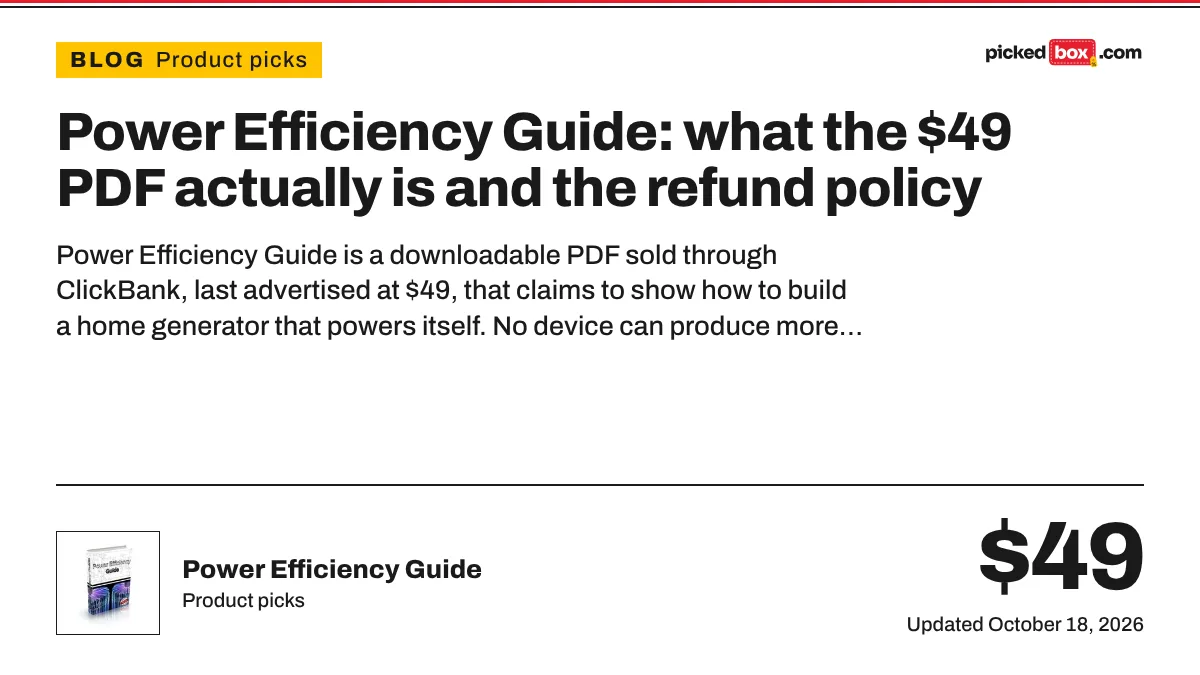
Power Efficiency Guide is a downloadable PDF sold through ClickBank, last advertised at $49, that claims to show how to build a home generator that powers itself. No device can produce more energy than it takes in, so the realistic value is low, and ClickBank's default 60-day refund window is the main protection for anyone who already bought it.
 PickedBox Team·Updated October 18, 2026·Offers checked October 8, 2026
 Power Efficiency Guide deals
What the Power Efficiency Guide is
Power Efficiency Guide is a digital guide, delivered as a download, that has been sold through the ClickBank marketplace for several years. Promotional pages credit it to a creator named Mark Edwards and describe it as step-by-step instructions to build a small home power source from parts you can buy locally.
The sales pitch, as summarized on older listings and the original version of this page, makes several claims:
- The device runs on a "spinning" principle and keeps itself going once started.
- It can power lights, a refrigerator and appliances, and can cut an electricity bill by about half or more.
- It needs no fuel and gives off no fumes.
- Bonus files cover a "Meyer Magnet Motor", a "Smith Generator", lighting history and reducing energy waste.
There is no physical product. The buyer gets PDF files and access to a members area.
Why a self-powering generator does not work
The central claim is a machine that produces usable electricity while powering itself. That is a description of perpetual motion. The first law of thermodynamics, conservation of energy, says a closed system cannot put out more energy than goes into it. Friction, heat and electrical resistance mean any real generator puts out less.
Magnet motor designs have the same problem. A permanent magnet stores no energy that can be drawn on forever. It can push or pull, but a magnet arranged in a loop settles into a resting position and stops. The US Patent and Trademark Office treats perpetual motion claims as inoperable and asks for a working model before it will consider them.
That does not mean every page of the guide is useless. General tips about turning off standby loads or switching to LED bulbs are sound. Those tips are also free from public sources, as covered below. The part a buyer is paying for, the self-running generator, cannot deliver power to a house.
Price and whether it is still sold
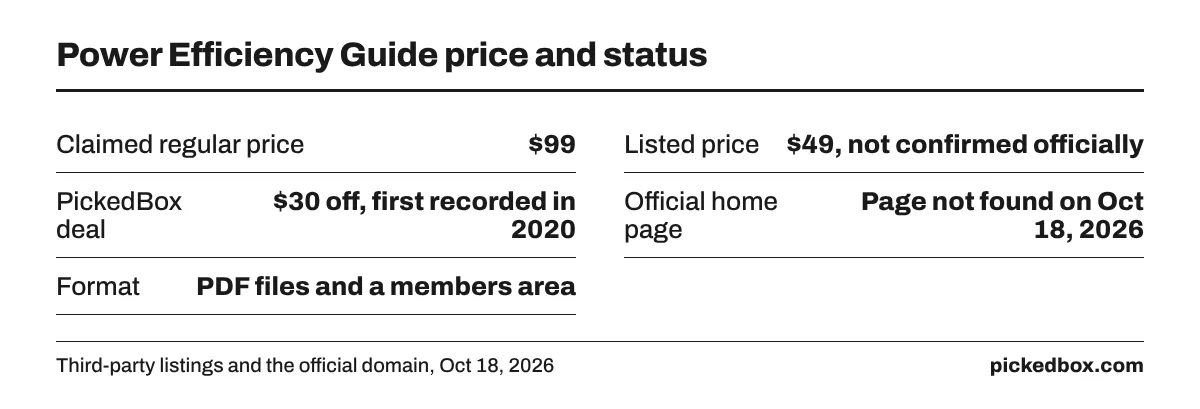
The figure most often attached to the guide is $49, shown on third-party listings as a reduced price against a claimed regular price of $99. That $49 price could not be confirmed on an official page in October 2026.
At the time of checking (Oct 18, 2026), the domain used for the sales page, powerefficiencyguide.com, returned a "page not found" error on its home page. The site's newest order and members pages were last changed in 2020, and old spam posts unrelated to energy sit on the same site. In plain terms, the guide does not appear to be actively sold from its own site in 2026, although copies and resellers may still exist.
The PickedBox Power Efficiency Guide page lists one deal, first recorded in 2020, for $30 off. No code is needed for it. Given the state of the official site, check that any checkout page you land on is a real ClickBank order form before paying.
How the ClickBank refund works
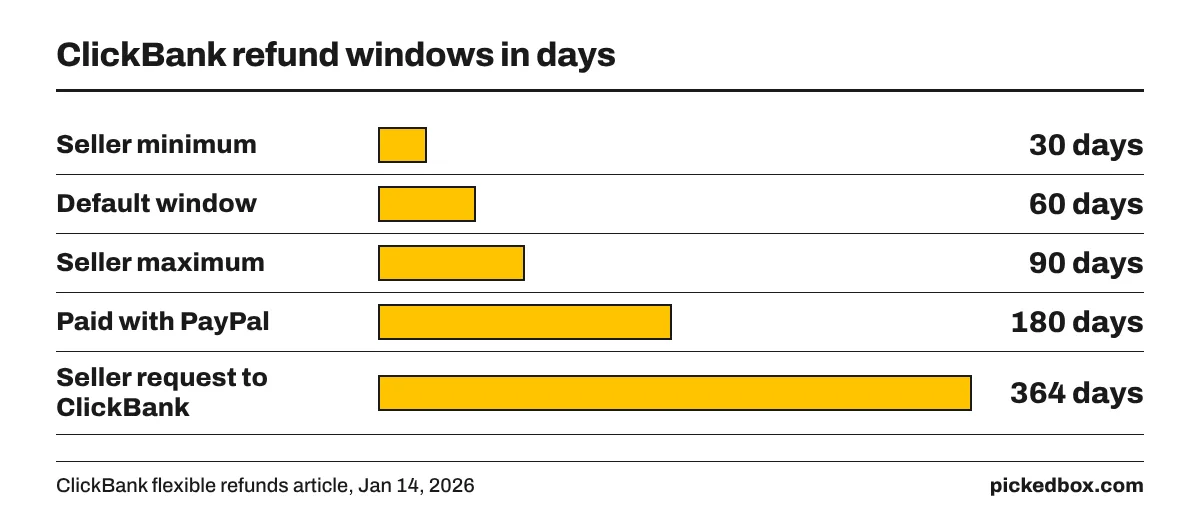
Because the guide was sold through ClickBank, refunds are handled by ClickBank, not by the creator directly. ClickBank's flexible refunds article, dated January 14, 2026, states:
- The default return period for products from ClickBank sellers is 60 days.
- Sellers may set a custom period between 30 and 90 days, or ask ClickBank for up to 364 days.
- Purchases paid with PayPal carry a 180-day refund period when the seller offers PayPal.
To request one, look up the order at clkbank.com with the email used at checkout and the order number, or the ZIP code or last four digits of the card. Then open a refund ticket from the order page. Once the window has passed, the refund option disappears and the only route is contacting the seller listed on the order.
Keep the ClickBank receipt email. It carries the order number and the exact refund period that applied to your purchase.
How to pay less on your electric bill instead
If the goal is a lower bill, the methods that work are documented for free by the US Department of Energy in its Energy Saver guidance:
- Heating and cooling first. An older DOE Energy Saver guide puts heating and cooling at about 43% of a typical utility bill, so a programmable or smart thermostat and sealed ducts usually matter more than anything else.
- Lighting. The DOE lighting page says LED bulbs use up to 90% less energy than incandescent bulbs and last up to 25 times longer. It puts lighting at about 15% of an average home's electricity use.
- Standby power. Electronics draw power when switched off. A power strip that cuts them fully stops that.
- Energy audit. Many utilities offer free or reduced-cost home energy audits, which point to the biggest losses in a specific house.
LED bulbs, smart power strips and thermostats are sold at hardware stores, and PickedBox lists current offers on the Home Depot coupon page. For larger upgrades, the guide to heat pump and smart thermostat rebates covers what is available in 2026.
The row below is the same row as on the Power Efficiency Guide page. Power Efficiency Guide opens in a new tab.
If you want backup power for outages
Some buyers were drawn to the guide as an emergency power source. Real options exist, and they are sold with specifications you can check before buying:
- Portable power stations store energy in a battery and are rated in watt-hours, which tells you how long they can run a given device.
- Solar panels paired with a power station recharge it during the day. Output depends on sunlight and panel wattage.
- Fuel generators run larger loads but must be used outdoors, away from windows, because of carbon monoxide.
Each of these takes energy in, from the grid, the sun or fuel, before it gives energy out. That is the honest test for any home power product: ask where the energy comes from.
Who the guide is for
The guide is hard to recommend to anyone who expects it to power a home or cut a bill in half, because the core device cannot do that. Someone who already bought it and is inside the refund window should use the ClickBank process above. Someone curious about home energy will get more reliable and current information for free from the DOE and from their local utility.
How we checked this
In October 2026, PickedBox checked the official domain powerefficiencyguide.com (home page error, newest pages dated 2020), ClickBank's flexible refunds article and the clkbank.com order lookup, the DOE Energy Saver lighting page and an older DOE Energy Saver guide, and third-party listings for the $49 price. The product claims are taken from older promotional copy. No copy of the guide was bought or used for this article, and no device was built.
- ClickBank flexible refunds (support article, Jan 14, 2026)
- ClickBank order lookup (clkbank.com)
- DOE Energy Saver: lighting choices save you money
- DOE Energy Savers guide (PDF)
- Perpetual motion (Wikipedia)
How we test codes and what the labels mean: How we verify coupons.
Related stores
Best offer on our latest check.
More from the blog
- Oct 18, 2026Heat pumps and smart thermostats: 2026 rebates and what they save
- Oct 18, 2026Flex Glue in 2026: sizes, price and where it is cheapest
- Oct 12, 2026Can Home Depot employees give discounts? What actually works in 2026
- Oct 18, 2026Zinus platform beds in 2026: prices by size and when Zinus discounts them